An EssaySapphic Regency
Sapphic Art
Women in love, in paint, from the 1730s to the Regency
If you want proof that people in Jane Austen’s century could picture two women in love, look at what they hung on their walls and sold in print shops. Some of it was romantic, some was religious, and one of my favorites is a cheeky cartoon.
None of this tells us who the artists loved, and I won’t pretend it does. It tells us the image existed, and that people knew what they were looking at.
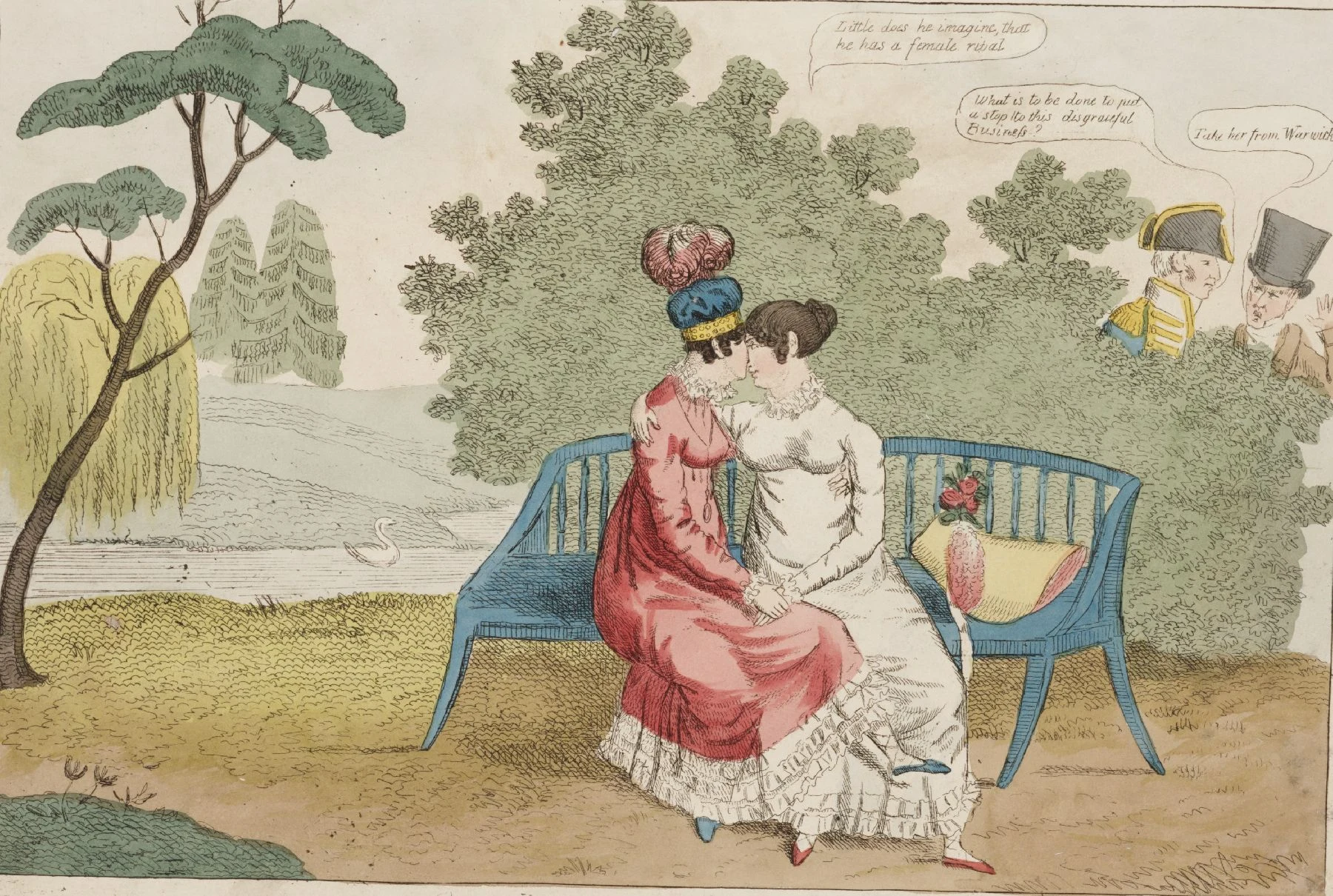
Two dear friends on a garden bench
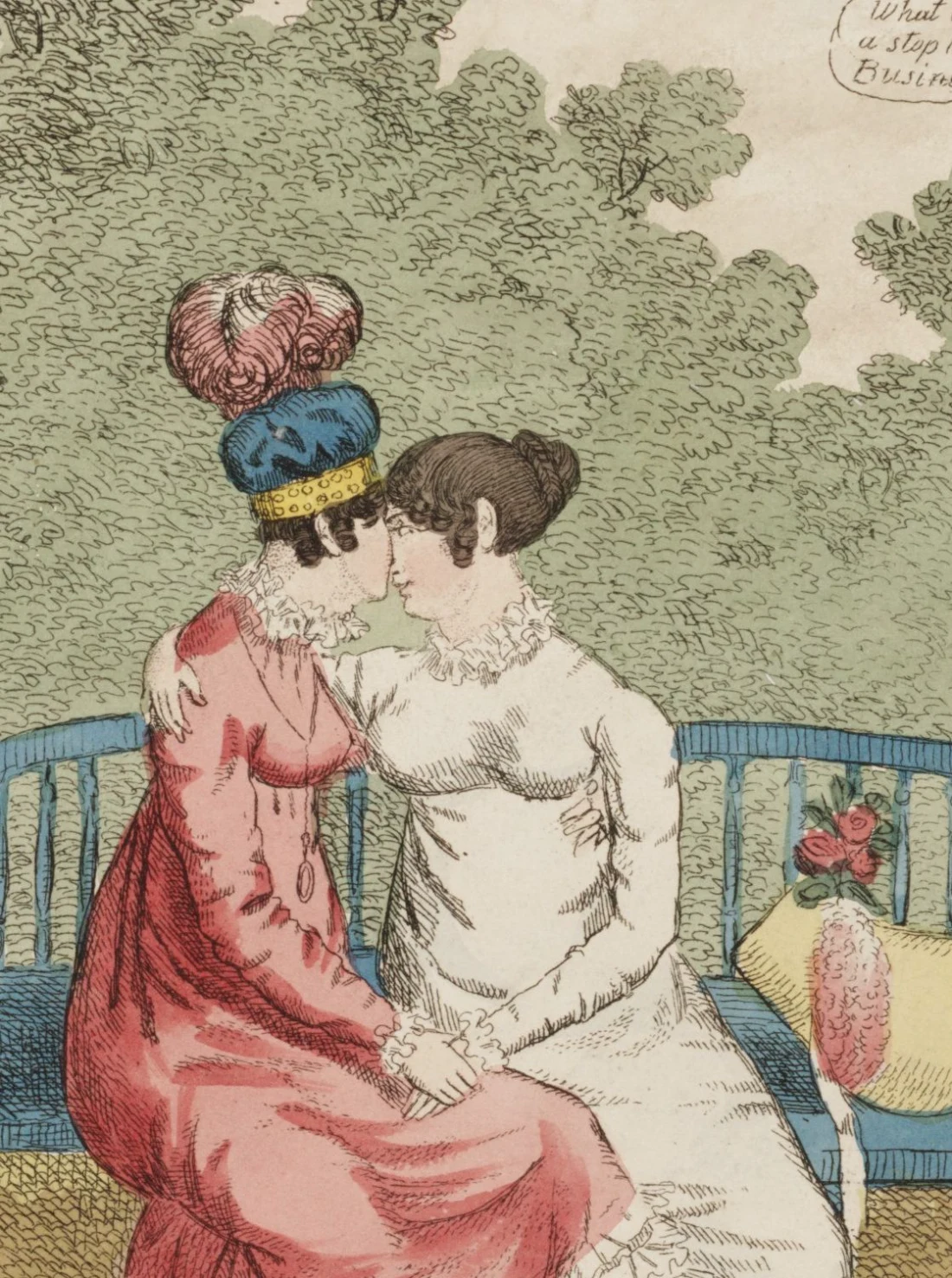
Let’s start with the funny one. “Love-à-la-mode, or Two Dear Friends” was published by a London print seller named Clinch in 1820, the year George IV became king. Two society women sit on a blue garden bench by a lake with a swan on it. One wears a red gown and a blue turban with a towering pink plume. The other is in white. They’re nose to nose, arms around each other, holding hands in their laps.
The speech bubbles do the rest. One of the women says, “Little does he imagine, that he has a female rival.” Over the hedge, two husbands are peeking. One, in an admiral’s hat, asks, “What is to be done to put a stop to this disgraceful Business?” The other says, “Take her from Warwick.”
The women are identified as Lady Strachan and Lady Warwick, real society wives who were already the subject of gossip. I love it because the joke only works if everyone buying it understands the idea of a “female rival.” Nobody in that print shop needed it explained. I’m obsessed with “Two Dear Friends” on a garden bench because I can only see the one as Caroline Bingley. It’s literally the same hair as Anna Chancellor in the 1995 Pride and Prejudice, and like, same style outfit and hat. That’s why she’s on my Caroline page.
I wrote a whole piece on this cartoon, with who the two women were and the gossip that followed them.
Boilly’s two young women
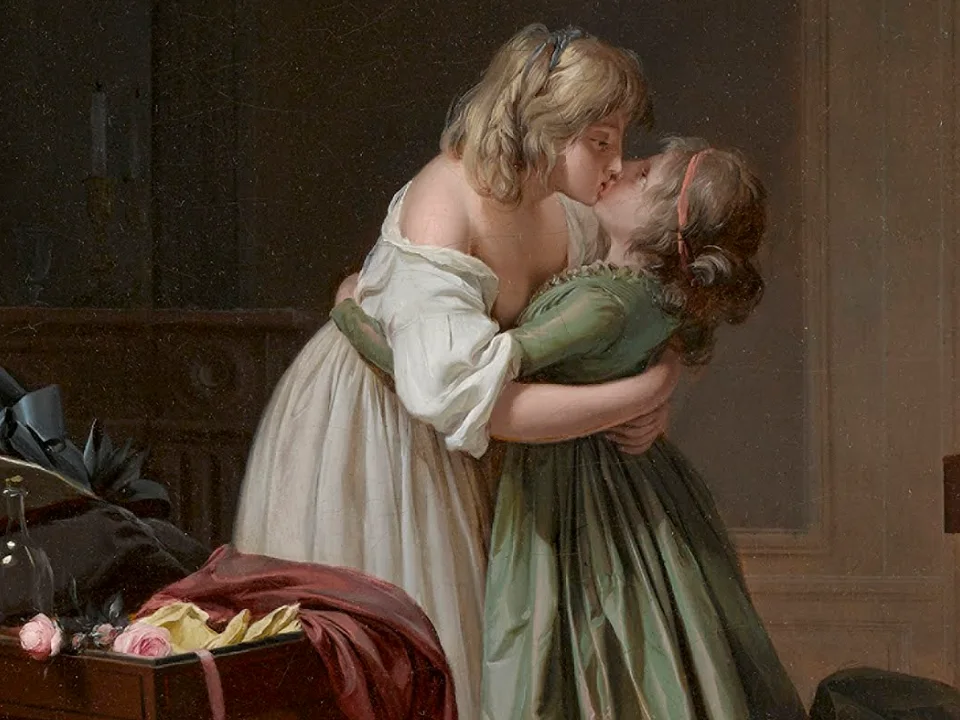
Louis-Léopold Boilly made his name painting everyday Paris, its crowds, cafés and drawing rooms. Around the time of the Revolution he painted this: two young women in a parlor, one in white and one in green, wrapped in each other’s arms and kissing. A red shawl lies tossed over a box beside them.
There’s no myth here and no allegory, no goddess and no Bible verse to hide behind. It’s two women in fashionable dress, kissing in a room that could be anyone’s. It’s in a private collection now, and it went on show at the Musée Cognacq-Jay in Paris for its Boilly exhibition in 2022. It’s also the picture at the top of this whole site.
Peace and Justice
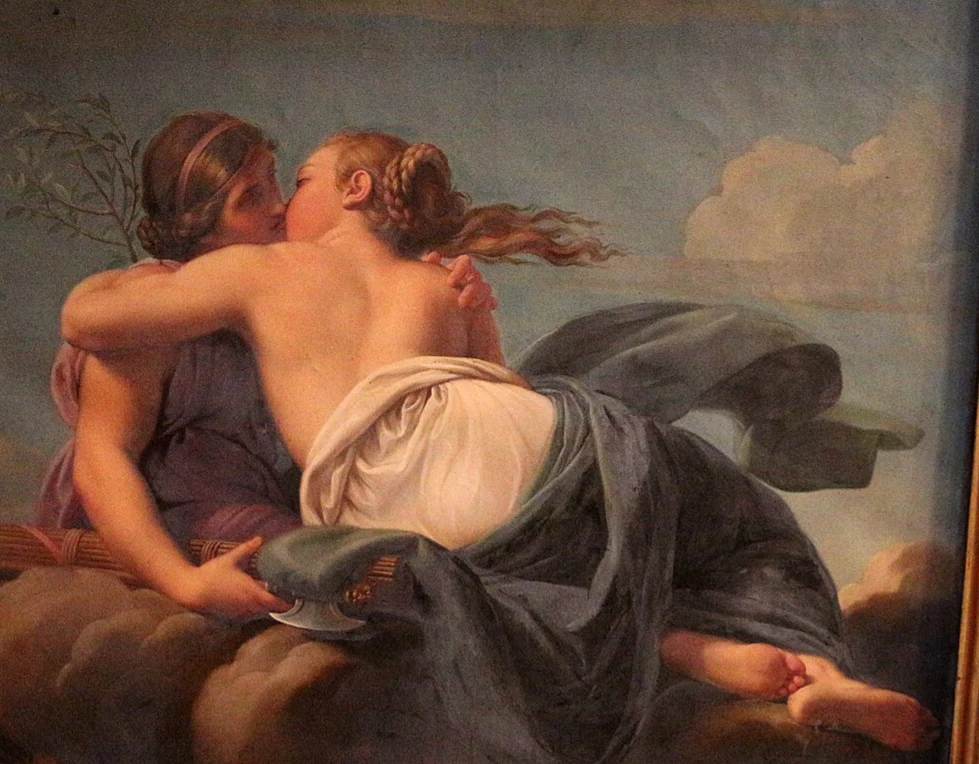
This one surprises people. Psalm 85 says that “righteousness and peace have kissed each other.” In Latin, Justice and Peace are both feminine, so for centuries painters showed them as two women sharing a kiss. Nobody could complain, because it was scripture.
Pompeo Batoni, who worked in Rome, painted the pair more than once in the late 1730s and 1740s. In this version they float on a cloud, one holding an olive branch for peace, the other with her hair streaming behind her, and they’re kissing as if nobody else is there. The Montreal Museum of Fine Arts owns one of his versions, painted to hang beside a matching Truth and Mercy.

Corrado Giaquinto painted the same embrace for the Spanish royal court in 1753 and 1754, as a compliment to the peaceful reign of Ferdinand VI. One wears a crown and holds a scepter, and the other leans in to her cheek. The finished canvas is in the Prado in Madrid.
A woman painter’s version
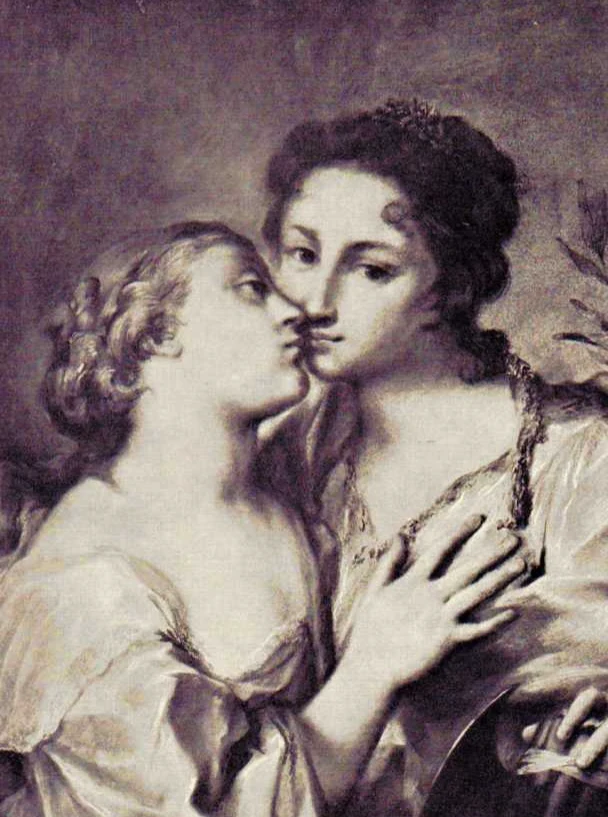
Rosalba Carriera was one of the most famous artists in Europe in her day, and she did it in pastel, which she made fashionable. She was a woman painter at a time when there weren’t many, and collectors all over Europe wanted her portraits.
Her Charity and Justice, which hung in the royal gallery in Dresden, shows another virtue pair as two women. One leans in until her lips almost touch the other’s cheek, and the other looks straight out at us, her hand on her heart. It’s softer than Batoni’s kiss, and somehow more intimate.
Diana, Callisto, and a god in disguise

Mythology gave painters another excuse. In Ovid’s Metamorphoses, the god Jupiter falls for Callisto, one of the goddess Diana’s nymphs, and wins her by taking Diana’s shape. So a painter could show Diana kissing Callisto and say, quite truthfully, that he was painting a god in disguise.
The French painter Nicolas-René Jollain painted the scene in 1770, with a dark-haired Diana and a fair Callisto in a woodland, a crescent moon in Diana’s hair and a cupid hanging garlands above them. The full painting is a classical nude, so I’m only showing you their faces.
Painting and Sculpture, in each other’s arms
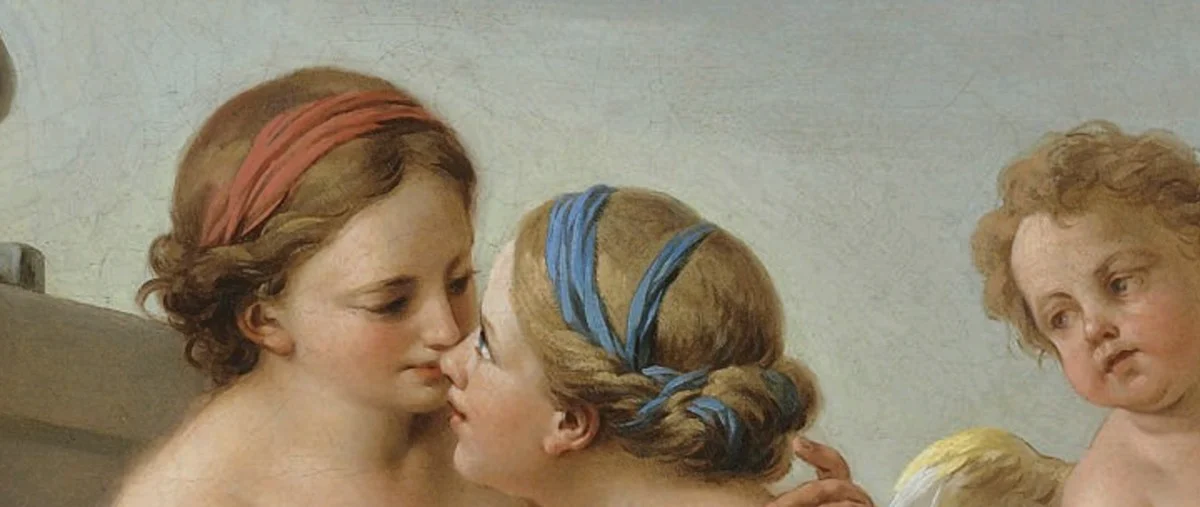
Louis-Jean-François Lagrenée painted the arts themselves as two young women. In The Union of Painting and Sculpture, one with a red ribbon in her hair and one with a blue ribbon embrace and lean in nose to nose, while a cupid holds up a picture frame and looks on. A palette and brushes lie at their feet, and a marble bust stands behind them.
Officially it’s about the arts working together. It’s also, unmistakably, two women about to kiss. Like the Jollain, the whole painting is a classical nude, so this is the part I’m showing you.
What these pictures do and don’t tell us
A Bible verse or a myth gave painters permission. A cartoon gave the public a laugh. None of it tells us who the artists loved, or the sitters, and some of it was meant to mock. But put it all together and you get the same answer as the diaries and the gossip in Sapphists and Tommies. People in Austen’s century could imagine two women in love, they painted it. And they paid good money to look at it.
For the real women behind all this, start with Anne Lister, the Ladies of Llangollen and Charity and Sylvia.
Quick Questions
Is there sapphic art from the Regency era?
Yes. The clearest is a hand-colored London cartoon from 1820, “Love-à-la-mode, or Two Dear Friends,” which shows two society women embracing on a garden bench. Louis-Léopold Boilly painted two young women kissing a generation earlier, in Paris.
Why did so many paintings show Peace and Justice kissing?
Because of a line in Psalm 85: “righteousness and peace have kissed each other.” In Latin, Justice and Peace are both feminine, so painters showed two women in a kiss, and nobody could object to a Bible verse.
Why did painters choose Diana and Callisto?
In Ovid’s myth, Jupiter takes the form of the goddess Diana to seduce the nymph Callisto. The story let artists paint two women embracing while officially painting a god in disguise.
Does this art prove the artists or models loved women?
No, and I won’t claim it does. What it shows is that pictures of women loving women were made, sold and hung on walls in Jane Austen’s century.
Sources
“Love-à-la-mode, or Two Dear Friends” (London: Clinch, 1820), hand-colored etching, Lewis Walpole Library, Yale University, public domain. Louis-Léopold Boilly, Two Young Women Kissing, about 1789 to 1793, private collection, public domain. Pompeo Batoni, Peace and Justice, photographed by Sailko, CC BY-SA 3.0, via Wikimedia Commons. Corrado Giaquinto, Justice and Peace, 1753 to 1754, photographed by Sailko, CC BY 3.0, via Wikimedia Commons, with the finished canvas in the Museo del Prado. Rosalba Carriera, Charity and Justice, from a 1905 print, public domain. Nicolas-René Jollain, Diana and Callisto, 1770, and Louis-Jean-François Lagrenée, The Union of Painting and Sculpture, 1768, public domain, shown as details. Psalm 85:10 is quoted from the King James Version.
Keep Reading
Back to Sapphic Regency →