An EssaySapphic Regency
Sapphists and Tommies
What Jane Austen’s era called women who loved women
Every time a period drama gives two women a love story, someone says people back then didn’t even have a concept for it. The people who lived back then would disagree. They gossiped about it in their diaries, joked about it in poems, drew cartoons of it and argued about it in court.
They also had words for it. Here they are, in the writers’ own spelling, straight from the page.
“Sapphist”
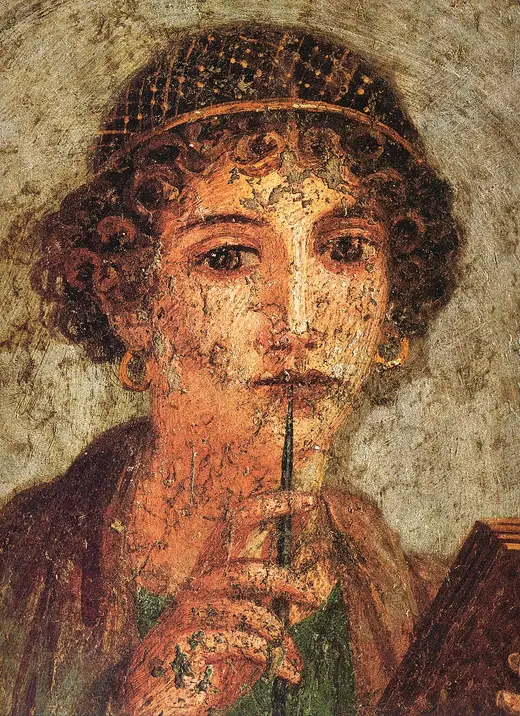
Our best witness is Hester Thrale, the friend of Samuel Johnson, who kept a gossipy diary she called Thraliana. In April 1789, a few months before the Bastille fell, she wrote that “The Queen of France is at the Head of a Set of Monsters call’d by each other Sapphists, who boast her Example.”
That’s a hostile sentence, and the part about Marie Antoinette was political smear, which I cover on the women page. But look at the middle of it. “Call’d by each other Sapphists.” Thrale is telling us women were using the word for themselves.
In June 1790 she turned to someone closer to home, the sculptor Anne Damer, “a Lady much suspected for liking her own Sex in a criminal Way.” And in a note around 1795 she spelled the idea out: “it has a Greek name now & is call’d Sapphism.” In the same note she says the actress Sarah Siddons told her that her own sister had once been in “personal Danger” from such a woman.
Thrale disapproved of every bit of it. That’s exactly why she’s useful. Nobody fumes in her diary about something that doesn’t exist.
I use “sapphic” myself and have since I came out. I like the term. I am a history nerd and always loved Greek mythology, so it fits. I like it way more than other terms because it can be an umbrella term and not pigeonhole sexuality.
“Tommy”
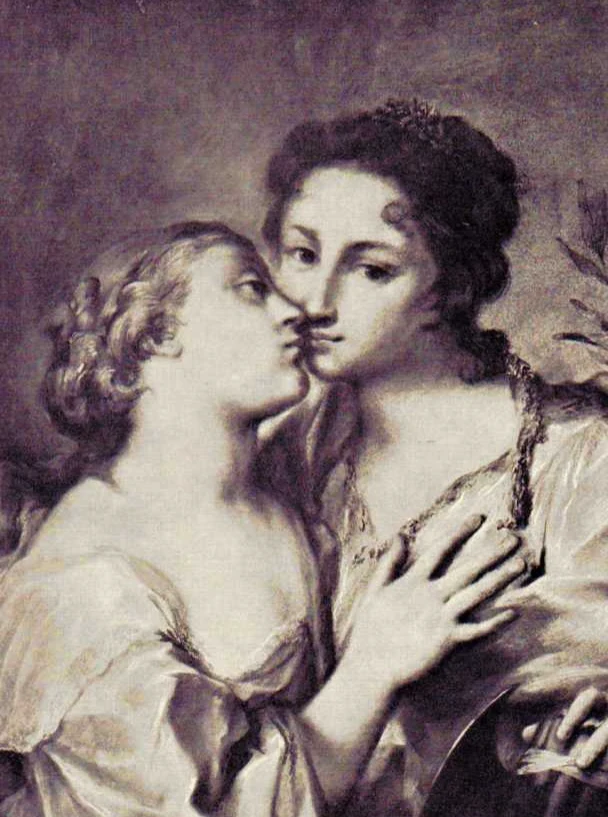
Where “sapphist” was a word for gossip, “tommy” was street slang. In 1773 an anonymous satire called The Adulteress sneered at women who “act the Manly Part,” and its narrator claims, “I know a thousand Tommies ’mongst the Sex.”
A London pamphlet from the 1770s, A Sapphick Epistle, aimed its jokes at Anne Damer again. One footnote calls Sappho “the first young classic maid that bestowed her affections on her own sex.” Then it says, “She was the first Tommy the world has upon record,” and adds, “though there hath been many Tommies since, yet we never had but one Sappho.”
Many Tommies since. Even a mean little pamphlet admits there were plenty of them.
The newspapers and the cartoonists
In August 1790 Town and Country Magazine, a London monthly famous for its gossip, ran a piece about the Ladies of Llangollen headed “Extraordinary Female Affection.” It said the two women “bear a strange antipathy to the male sex.” Then it described Eleanor Butler: “Miss Butler is tall and masculine. She wears always a riding-habit,” and “appears in all respects as a young man, if we except the petticoat, which she still retains.” It never said anything outright. It didn’t have to. The Ladies were upset enough that they asked the politician Edmund Burke for advice about suing.
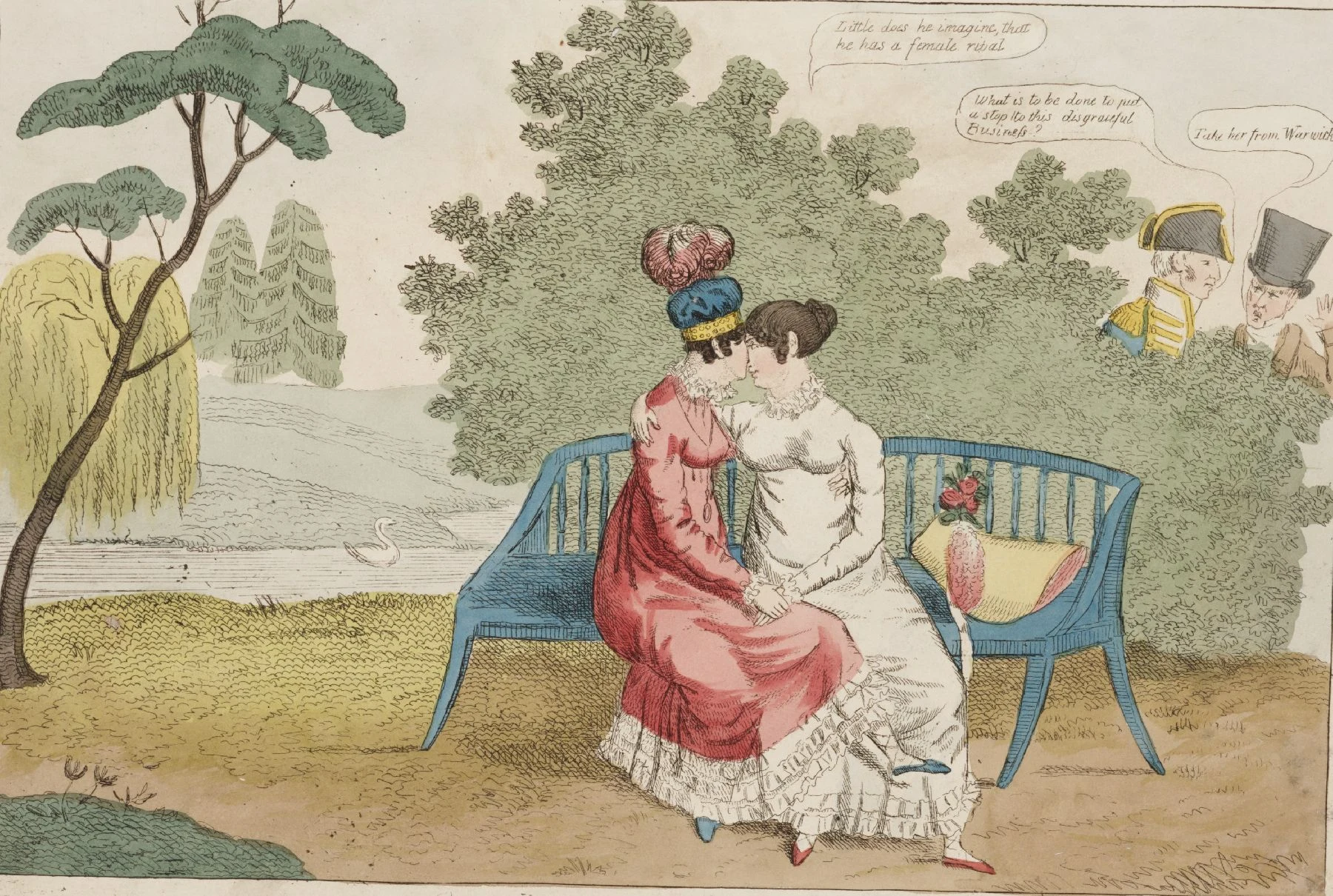
Thirty years later the hints had turned into a cartoon. “Love-à-la-mode, or Two Dear Friends,” published in London in 1820, shows two society women, Lady Strachan and Lady Warwick, nose to nose on a garden bench. One says, “Little does he imagine, that he has a female rival.” Their husbands peek over the hedge, and one of them asks, “What is to be done to put a stop to this disgraceful Business?” A print shop doesn’t sell a joke the public won’t get. I tell the whole story in Two Dear Friends.
The judges who didn’t want to believe it
In 1810 a pupil at a girls’ school in Edinburgh told her grandmother that her two teachers, Marianne Woods and Jane Pirie, were lovers. The school emptied within days, and the two women sued the grandmother for libel. The case dragged on for years.
The court papers, printed in 1812, are a strange read. One of the judges, Lord Meadowbank, admitted he had at first been inclined to think such a thing between women was “equally imaginary with witchcraft, sorcery” and other impossibilities. The lawyers answered by quoting Latin, Greek and French writers, with old words like “tribades,” to prove it had a long history. Woods and Pirie won in the end, but their school and their living were gone.
So even the men who insisted it couldn’t happen had to spend years arguing about it, with a stack of books on the table.
“Romantic friendship”
Not every word was an insult. Respectable people talked about “romantic friendship,” and that let a lot of love sit in plain sight. William Wordsworth wrote a sonnet to the Ladies of Llangollen calling them “Sisters in love, a love allowed to climb / Ev’n on this earth, above the reach of time.” Anne Lister, who knew what she was, went to Llangollen in 1822 hoping to find out what kind of love theirs was, and came away still wondering.
That’s the real picture. One set of words for scandal, one for slang and one for the drawing room, all at the same time. People didn’t lack a concept. They had several, and they chose which one to use depending on who they were talking about and who might be listening.
For the women themselves, start with Anne Lister, the Ladies of Llangollen and Charity Bryant and Sylvia Drake.
Quick Questions
What were lesbians called in the 1700s and early 1800s?
Gossip and satire used “sapphist,” from the Greek poet Sappho, and the slang word was “tommy.” Polite society talked about “romantic friendship.” “Lesbian” didn’t settle into its modern meaning until later in the 1800s.
When was the word sapphist first used?
It was in use by the 1780s. Hester Thrale wrote it in her diary in April 1789, about a set of women in Paris who called each other “Sapphists.”
Does tomboy come from tommy?
No. “Tomboy” is much older, from the 1500s, when it first meant a rowdy boy, and by the 1590s a boyish girl. “Tommy” for a woman who loved women turns up in the 1770s. Both come from “Tom,” the old stand-in name for any man.
Was it illegal for women to love women in Regency England?
There was no English law against sex between women, unlike the laws against sex between men. But an accusation could still destroy a woman’s reputation and living, as it did for two Edinburgh schoolmistresses in 1810.
Did Jane Austen know these words?
We can’t say. They don’t appear in her novels or in the letters that survive, but only about 160 of her letters are left. The words were in print and in fashionable gossip during her lifetime.
Sources
Hester Thrale’s words are from Thraliana, edited by Katharine C. Balderston (Clarendon Press, 1942), entries of April 1789 and 17 June 1790 and a note of about 1795. The Adulteress was published by S. Bladon in London in 1773. A Sapphick Epistle, from Jack Cavendish to the Honourable and Most Beautiful Mrs. D**** was sold by T. Southern in London in the 1770s. “Extraordinary Female Affection” is from Town and Country Magazine, August 1790, page 363. Lord Meadowbank’s view is reported in the printed papers of Miss Marianne Woods and Miss Jane Pirie against Dame Helen Cumming Gordon (1811–1812). The 1820 print “Love-à-la-mode, or Two Dear Friends,” published by Clinch, is public domain, from the Lewis Walpole Library, Yale University. The Pompeii fresco and Rosalba Carriera’s Charity and Justice are public domain. Tomboy dates follow the Oxford English Dictionary and Etymonline.
Keep Reading
Back to Sapphic Regency →