An EssaySapphic Regency
Charity and Sylvia
A tailor’s shop, a Vermont village, and a marriage in all but law
In 1807, while Jane Austen was living in Southampton and still years away from publishing anything, two women set up house together in Weybridge, Vermont. Charity Bryant was thirty. Sylvia Drake was twenty-two. They made clothes for their neighbors, taught Sunday school and spent the next 44 years together.
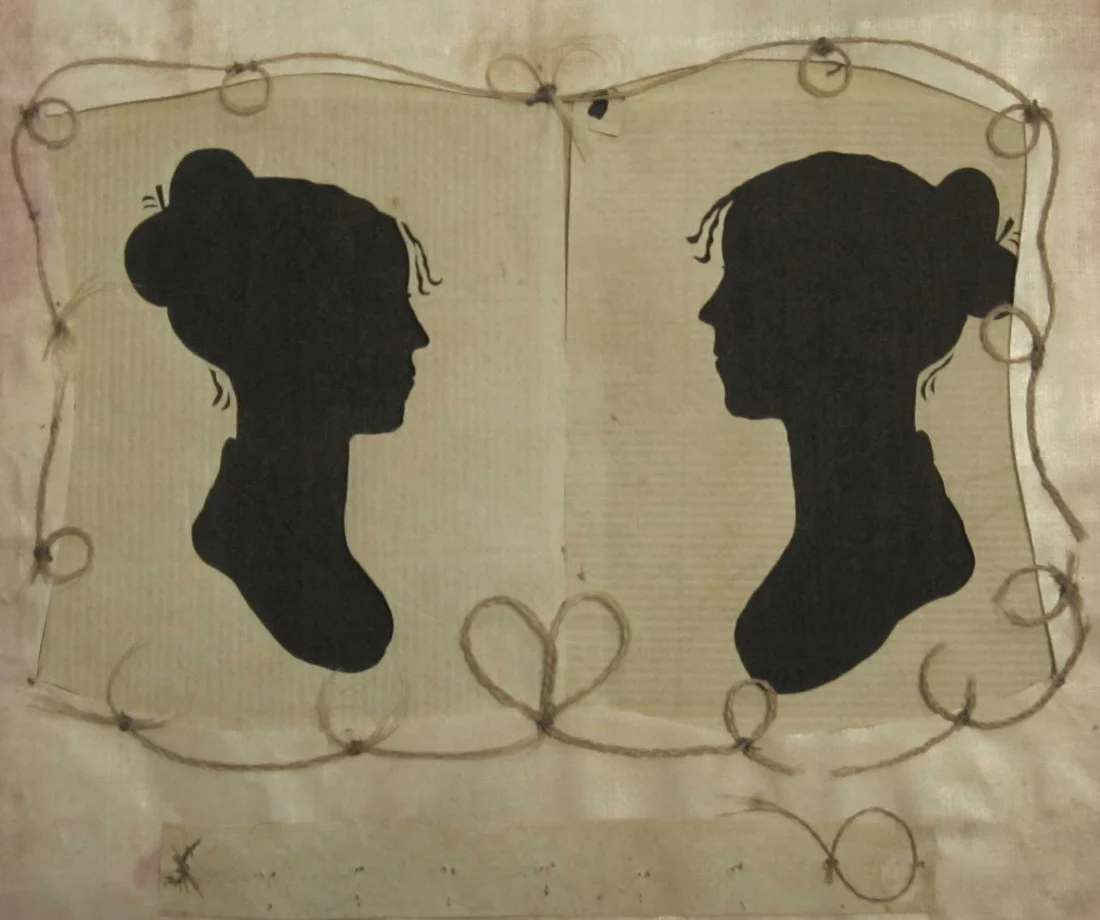
We know them so well because they kept everything: letters, poems, account books, a diary, and a silhouette of the two of them framed in their own braided hair.
Two girls from ten miles apart
Charity Bryant was born in North Bridgewater, Massachusetts, in 1777. Sylvia Drake was born seven years later in Easton, less than ten miles away, the youngest of eight children. They didn’t know each other growing up.
Charity became a schoolteacher, and her close friendships with young women caused gossip in more than one town. By twenty-three she had told her family she would never marry. Sylvia’s family, meanwhile, lost everything. Her father went bankrupt and died on the journey north, and in 1799 Sylvia and her mother settled in Weybridge, Vermont, where her older brother Asaph had set up a household.
A visit that turned into a life
In February 1807 Charity traveled to Weybridge to visit a friend, and there she met Sylvia Drake. She never left.
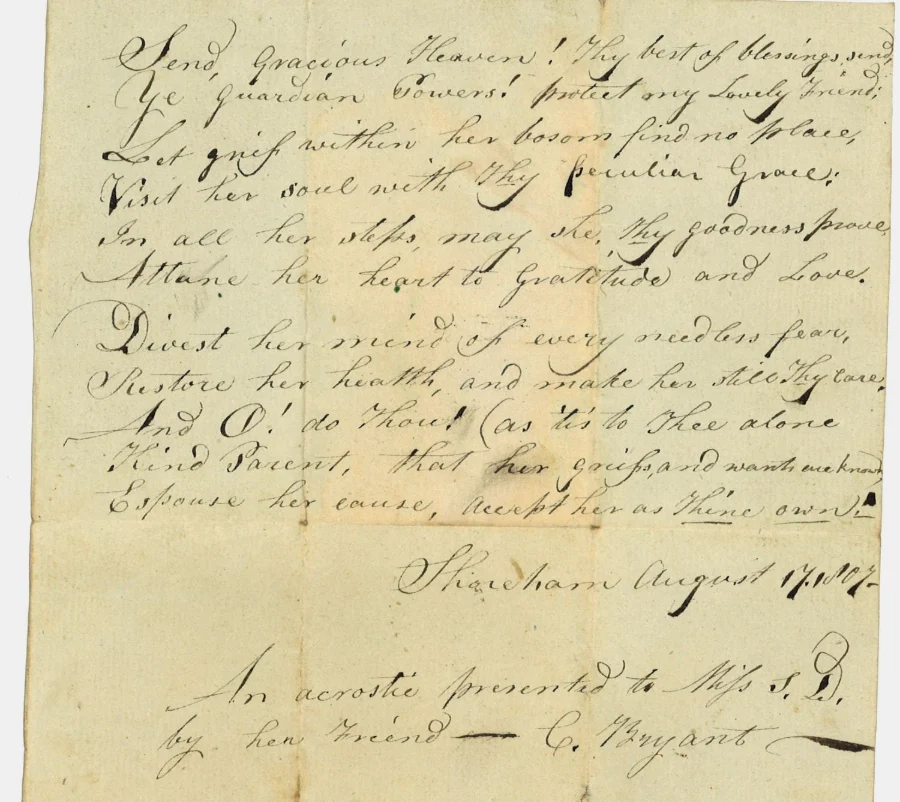
By August she was writing Sylvia poems. The one that survives is an acrostic, where the first letter of each line spells a name. Read down the left side and you get SYLVIA DRAKE. It begins “Send, Gracious Heaven! thy best of blessings send, Ye Guardian Powers! protect my Lovely Friend” and asks that grief should find no place in her bosom. It’s signed “by her Friend, C. Bryant,” and in 1807 that word, friend, could hold a great deal.
That summer Sylvia moved into Charity’s rented house. Decades later she was still marking the anniversary in her diary as the day she “commenced serving in company with Dear Miss B.” In 1809 they moved into a small house of their own on a quarter acre leased from a neighbor, and they stayed.
Two needles and an account book
They supported themselves by sewing, and not the genteel kind. Charity was an expert cutter, and they made vests, coats, suits and pantaloons for the men of the town, ministers included, along with women’s gowns, bonnets and cloaks. All of it was cut and stitched by hand, decades before the sewing machine. Men’s tailoring was usually a man’s trade, so two women doing it was unusual.
Sylvia did much of the stitching, and later young women from the village boarded with them and helped. Their account books are detailed, and they show how often neighbors paid in goods instead of cash. An Austen heroine with no fortune had to marry or become a governess. Charity and Sylvia found a third way, and it’s the same skill I wrote about in the Regency dressmaker, put to work across the Atlantic.
What the town called them
It took time. Sylvia’s family wasn’t happy at first, and her mother and some of her brothers kept their distance. But Charity and Sylvia became pillars of the Congregational church, taught Sunday school and kept up with both families. They helped raise and educate a crowd of nieces and nephews, and Sylvia’s mother eventually came to live in their house near the end of her life. On tax and census records, Charity was listed as head of the household, the way a husband would be.
In July 1843 Charity’s nephew came to visit. He was William Cullen Bryant, by then one of the most famous poets in America, and he wrote about it in a letter later printed in his book Letters of a Traveller (1850). He didn’t name them. He wrote of “two maiden ladies who dwell in this valley” who “took each other as companions for life,” a union “no less sacred to them than the tie of marriage.” They “slept on the same pillow and had a common purse,” he wrote, and when one fell ill, the other nursed her as “a fond wife attends her invalid husband.”
Then he stopped himself: “I have already said more than I fear they will forgive me for.” I love that line. He knew what he was describing, and he knew it was theirs to tell.
The cradle and the diary
Sylvia’s diary from the 1820s survives, and it’s full of small, domestic love. “My dear C rises before the sun. Does all the work,” she wrote one spring. Sylvia’s brother Asaph built them an adult-size cradle around 1815, a rocking bed for whoever was sick, and it turns up in the diary. “Felt quite sick have all that I need brot to the cradle,” she wrote in 1823. The cradle is still at the Henry Sheldon Museum.
Charity wrote poems all her life, and most of the ones that survive are to Sylvia. Near the end she asked for most of her writing to be burned. If that sounds familiar, it’s because Cassandra Austen did the same to Jane’s letters, which I write about in Was Jane Austen Gay? We’re lucky anything of Charity’s made it through.
Under one stone
Charity had heart trouble from 1839, and she died on 6 October 1851. They had lived together every day for 44 years except for about a month. Sylvia kept the business going on her own and spent her later years with her brother Asaph. She died on 13 February 1868, at eighty-three.
Her family buried her with Charity in Weybridge Hill Cemetery, and that summer a single headstone went up with both their names on it. Charity and Sylvia made me want to cry.
Middlebury and Weybridge
The Henry Sheldon Museum in Middlebury, Vermont, holds the silhouette, the cradle, Sylvia’s diary and a trunk of letters and poems that her brother’s descendants gave the museum in 1897. The silhouette is the only known picture of the two of them, and it traveled to the Smithsonian’s National Portrait Gallery for an exhibition on silhouettes in 2018 and 2019. The museum is open seasonally, so check its hours before you go. Their grave is a short drive away in Weybridge. I drove through Middlebury on my way out of Vermont after my trip to Stowe. If you’re making a Vermont trip of it, here’s my guide to Stowe.
If you want the whole story, read Rachel Hope Cleves’s Charity and Sylvia: A Same-Sex Marriage in Early America (Oxford University Press, 2014). It’s the book that brought them back.
Quick Questions
Who were Charity Bryant and Sylvia Drake?
Two women from Massachusetts who met in Weybridge, Vermont, in 1807. They ran a tailoring business from their home and lived together for 44 years, until Charity died in 1851.
Were Charity and Sylvia married?
Not legally. But their town came to speak of them in the language of marriage, Charity was listed as head of the household, and her nephew, the poet William Cullen Bryant, wrote that their union was “no less sacred to them than the tie of marriage.”
Where are Charity Bryant and Sylvia Drake buried?
Together, in Weybridge Hill Cemetery in Weybridge, Vermont, under a single headstone with both their names.
Where can I see the Charity and Sylvia silhouette?
At the Henry Sheldon Museum in Middlebury, Vermont, which holds the silhouette, their letters, Charity’s poems and Sylvia’s diary. Check the museum’s hours before you go.
Is there a book about Charity and Sylvia?
Yes. The historian Rachel Hope Cleves wrote Charity and Sylvia: A Same-Sex Marriage in Early America, published by Oxford University Press in 2014.
Were Charity and Sylvia alive at the same time as Jane Austen?
Yes. Charity was born in 1777, two years after Austen, and the two women set up house together in 1807, the year Austen was living in Southampton and four years before Sense and Sensibility came out.
Sources
The silhouette of Charity Bryant and Sylvia Drake (artist unknown) and Charity Bryant’s 1807 acrostic are public domain, via Wikimedia Commons, from the Henry Sheldon Museum, Middlebury, Vermont. William Cullen Bryant’s words come from his letter of 1843, as published in Letters of a Traveller (1850). Dates and diary details come from the Henry Sheldon Museum and Rachel Hope Cleves’s Charity and Sylvia (2014).
Keep Reading
Back to Sapphic Regency →