An EssaySapphic Regency
Two Dear Friends
The cartoon, the two ladies, and the gossip that followed them
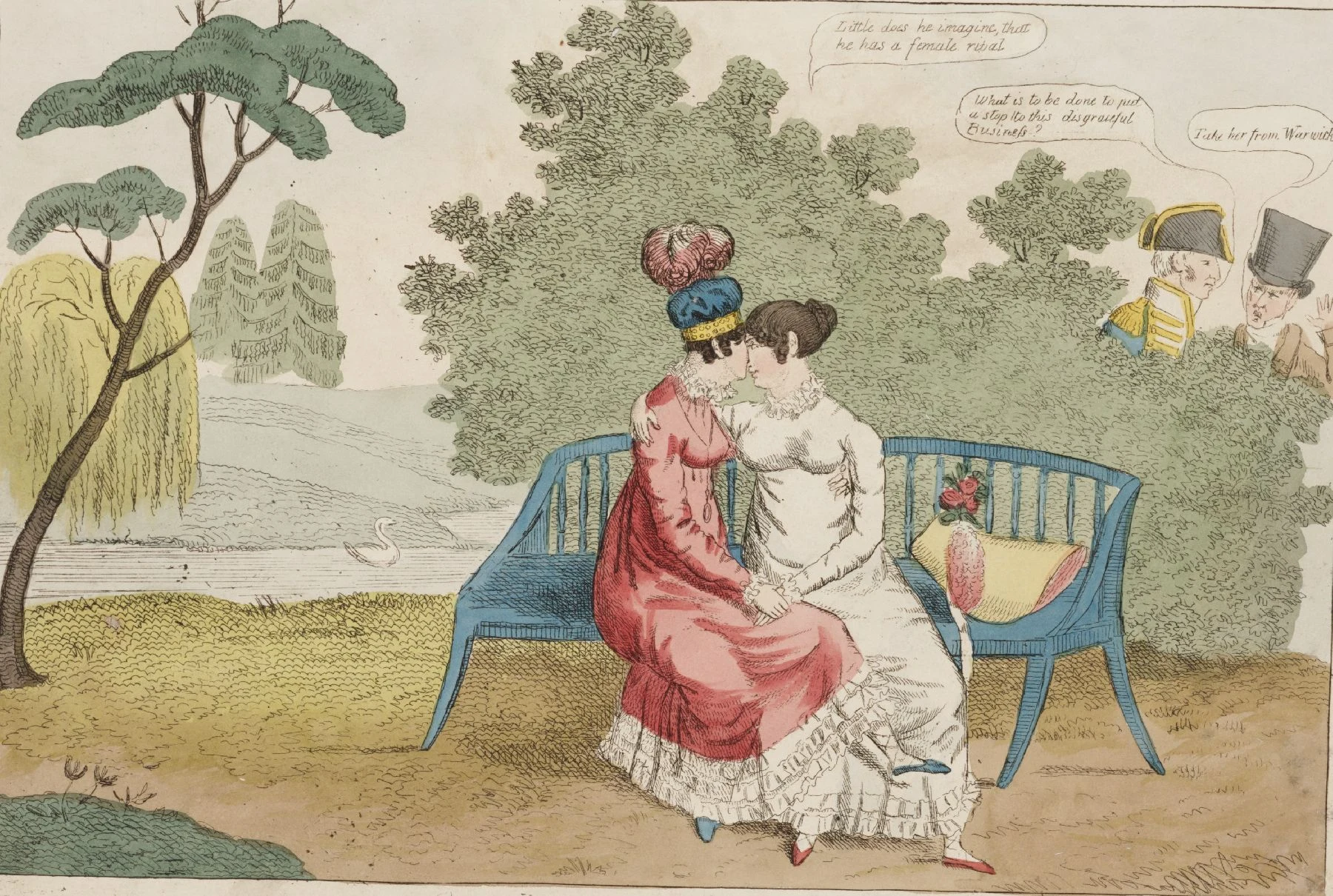
In 1820, the year George IV became king, a London print seller named Clinch put out a hand-colored cartoon called “Love-à-la-mode, or Two Dear Friends.” It shows two real society women in each other’s arms on a garden bench, while their husbands spy on them from behind a hedge.
I saw “Two Dear Friends” and thought of Lady Whistledown. It’s cheeky, it’s a little mean, and it’s one of my favorite things in this whole collection. Here’s who they were and what the joke was.
A bench, a swan, and a hedge
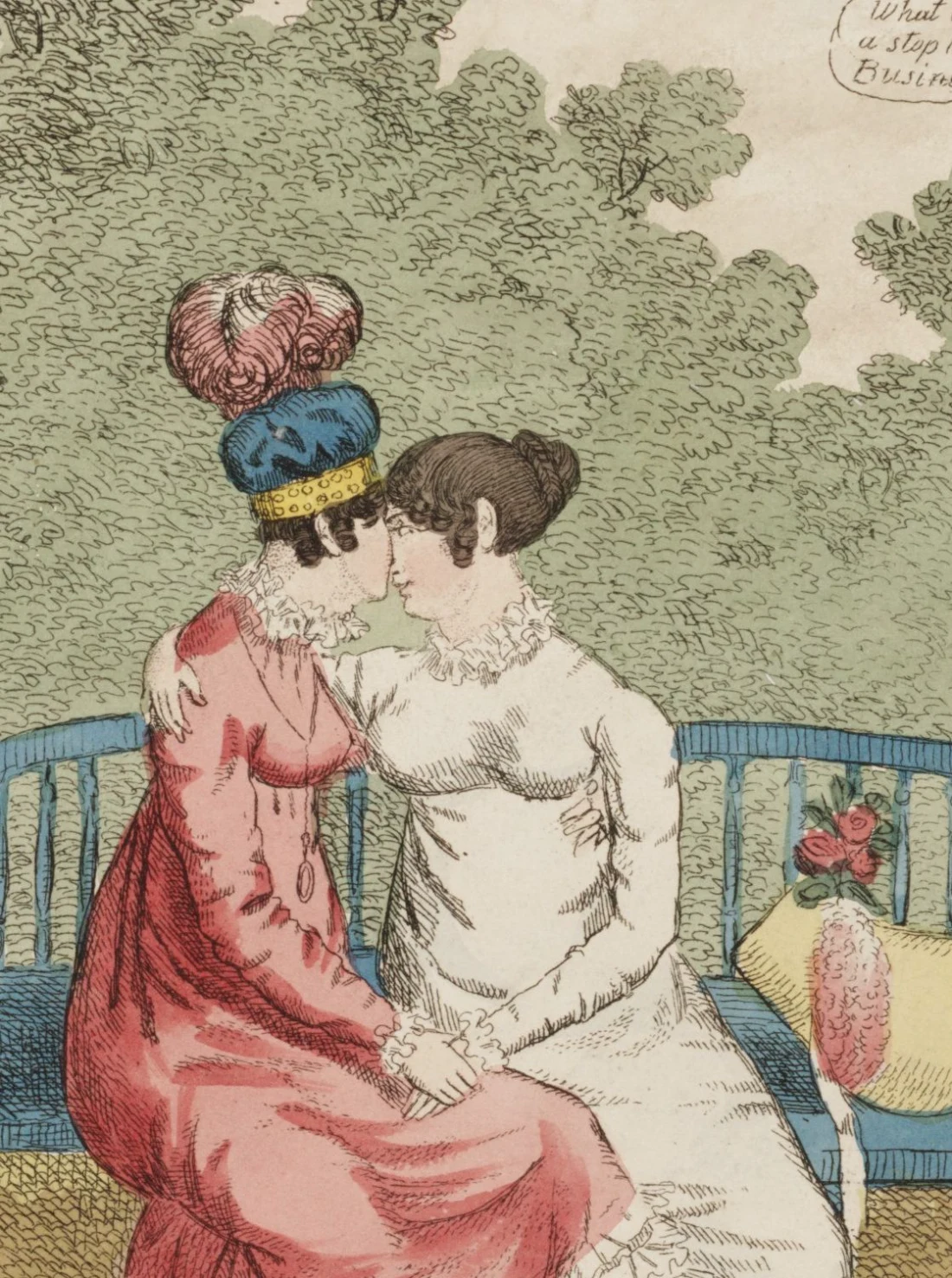
The setting is a park, with a willow, a lake and a swan. On a blue bench sit two women. One wears a red gown and a blue turban with a tall pink plume on top. The other is in white, with her dark hair pinned up. They’re nose to nose, one arm around a shoulder, one around a waist, and their hands are clasped in their laps. A straw bonnet with a pink feather has been set aside on the bench.
One of them says, “Little does he imagine, that he has a female rival.”
On the right, two men pop up over the hedge. One, in an admiral’s cocked hat and gold epaulettes, asks, “What is to be done to put a stop to this disgraceful Business?” The other, in a top hat, holds up his hand and answers, “Take her from Warwick.” It’s probably a pun on Warwick Castle, the Warwick family seat. The admiral doesn’t look reassured.
Who they were
Louisa, Lady Strachan was born Louisa Dillon. In 1812 she married Sir Richard Strachan, an admiral from the wars with Napoleon, nicknamed “Mad Dick.” They had three daughters. Later she became the mistress of the very rich Marquess of Hertford. She ended her days in Naples with an Italian title, the Marchesa di Salza, and died in 1868.
Sarah Elizabeth, Countess of Warwick was born Lady Sarah Savile in 1786, a daughter of the Earl of Mexborough. At 21 she married Lord Monson, and two years later she was a widow with a young son. In October 1816 she married Henry Greville, the 3rd Earl of Warwick. Later in life she was known for her charity, and her obituary praised “one undiminishing and unceasing course of charity, kindness and benevolence.” She died in 1851.
So the cartoon puts an admiral’s wife together with the countess of Warwick Castle, and makes their husbands the joke. Were the two women lovers? There’s no evidence they were, and I won’t claim it. The cartoon is satire, and satire doesn’t need to be true. It only needs the audience to get it.
There was a second cartoon
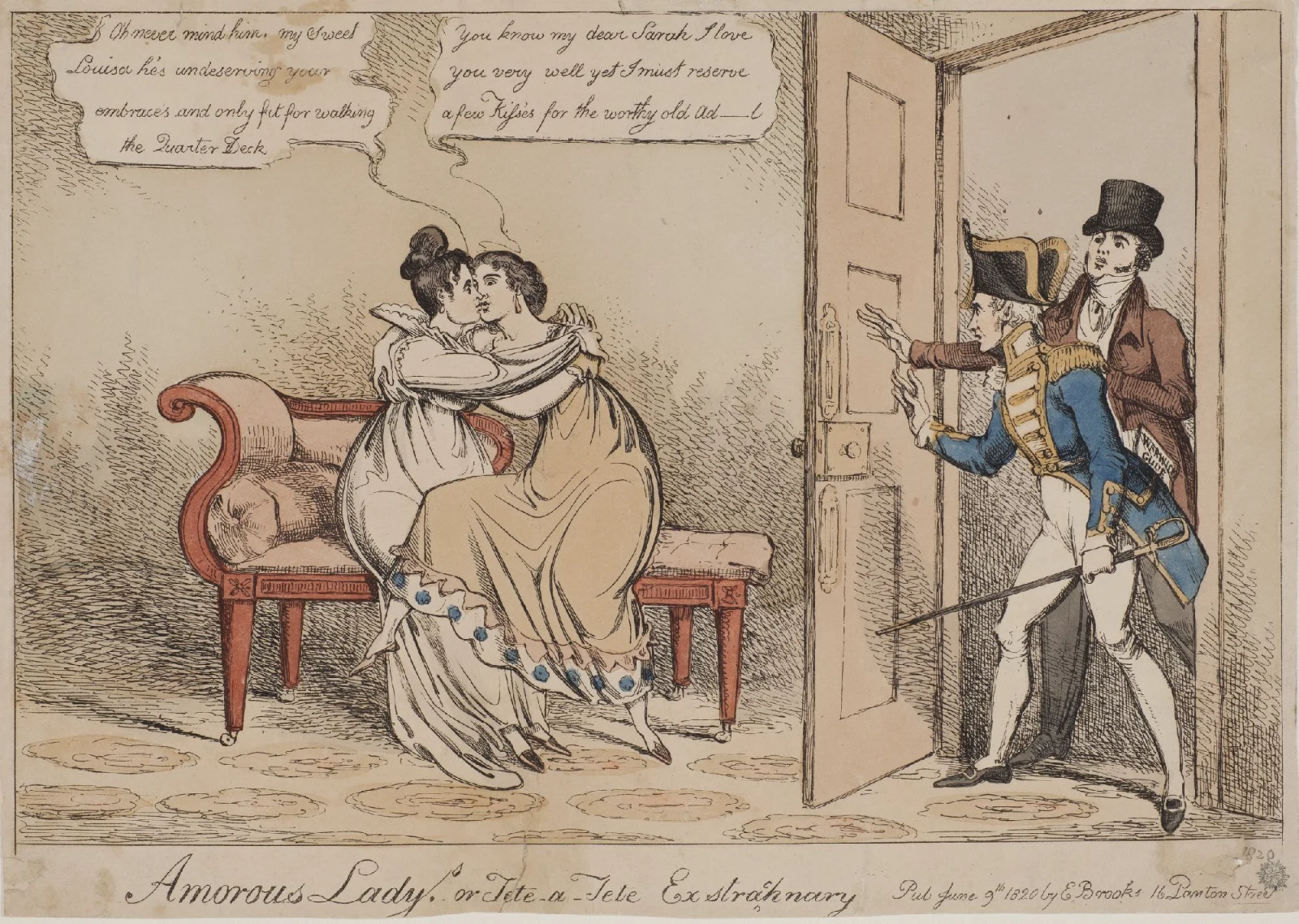
One cartoon wasn’t enough. On 9 June 1820 another print seller, E. Brooks of Panton Street, put out “Amorous Ladys, or Tête-à-tête Ex-strach-nary.” Read that last word out loud. It’s “extraordinary” with Strachan’s name stuffed into the middle.
This time the scene is indoors and far less discreet. The two women are on a sofa, Louisa sitting in Sarah’s lap, and they’re kissing. Louisa says, “You know my dear Sarah I love you very well yet I must reserve a few Kisses for the worthy old Ad-l,” meaning her admiral. Sarah answers, “Oh never mind him, my Sweet Louisa he’s undeserving your embrace’s and only fit for walking the Quarter Deck.”
The door has just swung open. In comes the admiral in his blue coat and cocked hat, sword in hand, arms out in horror, and behind him Lord Warwick, clutching a guidebook marked “Warwick” and looking as if he’d rather be anywhere else. Neither woman has noticed them.
A poem passed off as Byron’s
Their names kept turning up. Don Leon is a long, scandalous poem that was printed in the 1860s as Lord Byron’s, though almost nobody now believes he wrote it. Among its catalogue of scandals is a couplet about two ladies identified only as “S......n and W.....k” who “ask no joys beyond each other’s smock.”
The editor’s note spells it out. “These two names (Lady Strachan and Lady Warwick) seem to have been selected by the author, because they had obtained some notoriety,” it says, and it adds, “There was a caricature of these two ladies in the window of Fores’ shop in Piccadilly some years ago.”
That last line is a lovely detail. Fores was one of the great London print shops, and shops like it put the latest caricatures in the window, where crowds gathered to look and laugh. That was the Regency’s version of a tabloid front page, and these two women were on it.
They weren’t the only ones
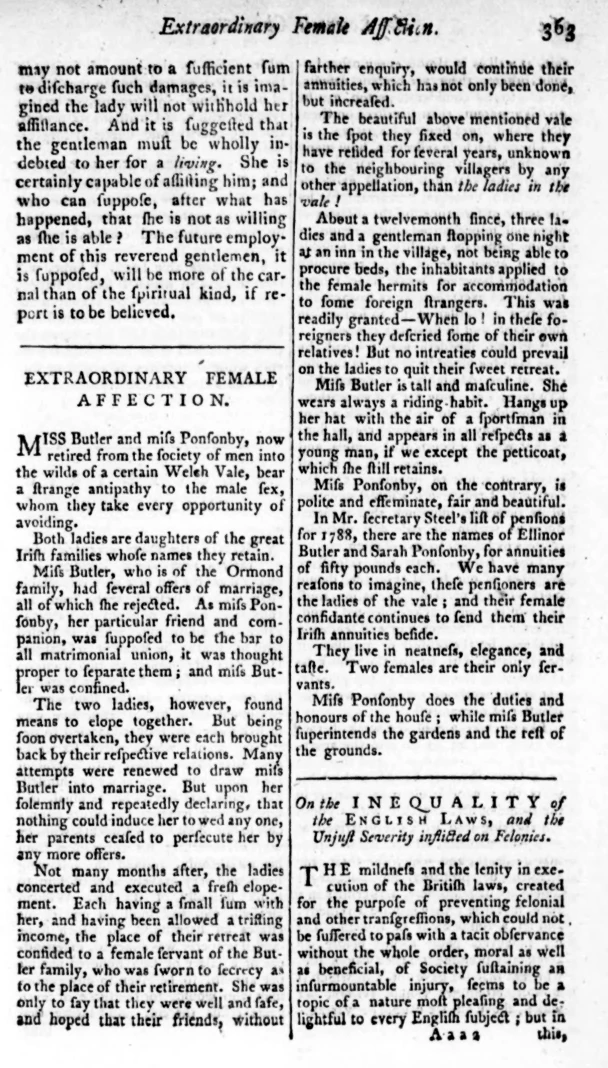
If you want a real Lady Whistledown, try Town and Country Magazine, a London monthly famous for its gossip. In August 1790 it ran a piece headed “Extraordinary Female Affection,” about two women it called “Miss Butler and miss Ponsonby,” better known as the Ladies of Llangollen.
It says they “bear a strange antipathy to the male sex,” tells the story of their two elopements, and calls them “the ladies in the vale.” Then it goes for the details. “Miss Butler is tall and masculine. She wears always a riding-habit,” it says, and “appears in all respects as a young man, if we except the petticoat, which she still retains.” Sarah Ponsonby, “on the contrary, is polite and effeminate, fair and beautiful.” Eleanor and Sarah were furious and asked Edmund Burke about suing.
Back in the 1770s, a pamphlet called A Sapphick Epistle had aimed its jokes at the sculptor Anne Damer and called Sappho “the first Tommy the world has upon record.” I’ve gathered all the words they used, from “sapphist” to “tommy,” in Sapphists and Tommies.
You can’t mock what nobody believes in
Every one of these was meant to wound, and some of them did. But read together, they answer the question people always ask about period dramas. Did anyone back then even imagine two women in love? A magazine described it in 1790, print shops sold it twice in 1820, and a poem was still repeating the gossip decades later. Everyone in on the joke knew exactly what “a female rival” meant.
And yes, the lady in red with the feathered turban looks just like Anna Chancellor’s Caroline Bingley in the 1995 Pride and Prejudice, which is why she’s at the top of my Caroline page. You can see more art like this in Sapphic Art.
Quick Questions
Who are the women in the Love-à-la-mode cartoon?
Louisa, Lady Strachan, wife of Admiral Sir Richard Strachan, and Sarah Elizabeth, Countess of Warwick, wife of the 3rd Earl of Warwick. Both were real society women, and their husbands are the two men peering over the hedge.
Were Lady Strachan and Lady Warwick really a couple?
There’s no evidence they were. The cartoon is a joke at their expense, and later gossip repeated it. What it proves is that the public in 1820 understood the idea of two women as lovers well enough to laugh at it.
Were there other cartoons of Lady Strachan and Lady Warwick?
Yes. On 9 June 1820 E. Brooks published “Amorous Ladys, or Tête-à-tête Ex-strach-nary,” which shows the two women kissing on a sofa as their husbands burst in. The title is a pun on “extraordinary” and Strachan’s name.
Where were cartoons like this sold?
In print shops in London, which displayed the newest caricatures in their windows so passers-by could crowd round and look. An 1860s note says a cartoon of these two women hung in the window of Fores’s shop in Piccadilly.
Did Regency magazines gossip about women who loved women?
Yes. In August 1790 Town and Country Magazine ran a piece called “Extraordinary Female Affection” about the Ladies of Llangollen, describing Eleanor Butler as “tall and masculine” and the pair as bearing “a strange antipathy to the male sex.”
Sources
“Love-à-la-mode, or Two Dear Friends” (London: Clinch, 24 Princes Street, 1820), hand-colored etching, Lewis Walpole Library, Yale University, public domain. It is catalogued in M. Dorothy George’s Catalogue of Political and Personal Satires (British Museum, vol. 10, no. 14075), and a copy is in the Wellcome Collection. “Amorous Ladys, or Tête-à-tête Ex-strach-nary” (London: E. Brooks, 16 Panton Street, 9 June 1820), hand-colored etching, questionably attributed to William Heath, is in the Cushing/Whitney Medical Library, Yale University, public domain. Biographical details come from the Wellcome Collection’s catalogue record and the published records of the Strachan and Greville families. The Don Leon couplet and note are from the edition printed in the 1860s. “Extraordinary Female Affection” is from Town and Country Magazine, August 1790, page 363, public domain, via the Internet Archive and Wikimedia Commons.
Keep Reading
Back to Sapphic Regency →