An EssaySapphic Regency
Is Caroline Bingley Gay?
The case from Pride and Prejudice itself
I’ve read Caroline Bingley as gay for years, more than any other character in Austen. Once you see it, you can’t stop seeing it. She’s chasing a man she never seems to want, and she can’t take her eyes off the woman she supposedly can’t stand.
I always read her as people contemporarily read Regina George. She’s a mean girl because she doesn’t understand and is obsessed with performatively finding the highest status man and putting down women because she can’t deal with herself. Picture her asking Elizabeth, “Why are you so obsessed with me?” while she’s the one who can’t stop watching.
I’ve already written my defense of Caroline. This is the rest of it. With real people who’ve died I won’t guess. Caroline is fiction, so here I’ll read as hard as I like, and every quote is Austen’s.
She wants Pemberley, not Darcy
Read every scene where Caroline flirts with Darcy and count how often she’s talking about him. It’s almost never. She praises his letter-writing, his sister and, most of all, his house. “What a delightful library you have at Pemberley, Mr. Darcy!” She never once says or thinks anything that sounds like wanting him.
That makes sense for a woman in her position. Her family’s money came from trade, and her brother still hasn’t bought an estate. Marrying Darcy would fix all of that in one stroke. Look at how her story ends. When Darcy marries Elizabeth, Caroline swallows it because “she thought it advisable to retain the right of visiting at Pemberley,” and she becomes “fonder than ever of Georgiana.” The house and the sister. Not the man.
She can’t stop looking at Elizabeth
Follow Caroline and Elizabeth from the start. After the first round of visits, Caroline and her sister want to be “better acquainted” with Jane and Elizabeth. The Bingley sisters are the ones reaching out. Elizabeth sees “superciliousness in their treatment of everybody” and “could not like them.” Caroline is interested, and Elizabeth gives her nothing back.
Then comes the party at Lucas Lodge. Elizabeth has just turned Darcy down for a dance, and Caroline sweeps up to him, sure he’s as bored as she is. “I was never more annoyed! The insipidity, and yet the noise” of “all these people!” Darcy tells her she’s wrong. He’s been thinking about “a pair of fine eyes in the face of a pretty woman,” and the eyes are Elizabeth’s. Caroline’s answer is “I am all astonishment. How long has she been such a favourite? and pray when am I to wish you joy?” Then she jokes about what a “charming mother-in-law” he’ll have, and “her wit flowed along.”
From that moment she can’t leave Elizabeth alone. At Netherfield she begins “abusing her as soon as she was out of the room.” Elizabeth has “no conversation, no style, no taste, no beauty,” and “Her hair so untidy, so blowzy!” Then, one evening while Jane is still ill upstairs, Caroline gets up, walks the room, and turns to her. “Miss Eliza Bennet, let me persuade you to follow my example, and take a turn about the room.” Austen says the point is to make Darcy look up, and it works. But of everyone in that drawing room, the person Caroline chooses to walk beside is Elizabeth.
It doesn’t stop. Months later, when Elizabeth calls at Pemberley, Caroline waits for her to leave and then greets Darcy with “How very ill Eliza Bennet looks this morning, Mr. Darcy,” followed by a full inventory of her face. Then she reaches back to something Darcy said “one night, after they had been dining at Netherfield,” back before he’d ever noticed Elizabeth’s eyes, and quotes it to him word for word. “She a beauty! I should as soon call her mother a wit.” It wasn’t even her own insult, and she still has it memorized.
The line I can’t unhear
After Elizabeth leaves the room one evening, Caroline says, “Eliza Bennet is one of those young ladies who seek to recommend themselves to the other sex by undervaluing their own.” She means Elizabeth is playing to the men by acting above the other women. I read it as a woman who has studied exactly how women perform for men, because she’s had to learn the act herself and hates having to do it.
Her famous speech on what makes a woman accomplished points the same way. It ends with “a certain something in her air and manner of walking.” She has thought very carefully about how women move.
Who she’s jealous of
The usual reading is simple. Caroline wants Darcy, Darcy wants Elizabeth, so Caroline hates Elizabeth. But look at where her attention goes. Darcy says one kind thing about Elizabeth’s eyes, and Caroline answers with a whole book’s worth of commentary on Elizabeth’s hair, face, walk, manners and family. She was interested in Elizabeth early on, and Elizabeth turned her away. Read it that way and it’s worse for her. She has to watch the man she’s supposed to want fall for the woman she can’t stop watching.
What this reading changes
Caroline usually gets played as a snob and a villain. Read her as gay and she becomes one of the saddest women in the book. She’s chasing a marriage she doesn’t want because it’s the only safe future on offer, performing an interest she doesn’t feel, and losing anyway. Real women of her time made that same bargain. Anne Lister watched the woman she loved, Mariana Belcombe, marry a rich man for security. You can read about her on my Anne Lister page.
It also explains why Caroline is more complicated than her reputation. She’s the one who warns Elizabeth about Wickham, and she’s right. I’ve been arguing for years that she deserves a second look. This is the look I’d give her.
Quick Questions
Is Caroline Bingley gay in Pride and Prejudice?
Austen never says so, and nobody in 1813 would have put it that way. It’s a reading, and fictional characters are fair game for readings. I think the text supports it better than people expect.
Was Caroline Bingley in love with Mr. Darcy?
She wants to marry him, but the book never shows her wanting him. Almost everything she says to him is about Pemberley, his library or his sister.
Why does Caroline Bingley dislike Elizabeth Bennet?
The usual answer is jealousy over Darcy. But she watches Elizabeth constantly, talks about her when she isn’t there, and invites her to walk the room with her. Her fixation is on Elizabeth as much as on Darcy.
Does Caroline Bingley ever marry?
Not in the novel. At the end she makes peace with the Darcys so she can “retain the right of visiting at Pemberley,” and becomes “fonder than ever of Georgiana.”
What does “take a turn about the room” mean?
It meant walking slowly around the drawing room, often arm in arm, to stretch your legs after sitting. Caroline asks Elizabeth to do it with her one evening at Netherfield.
Are other Austen characters read as queer?
Yes. Emma’s fascination with Harriet Smith is a famous one. I also wrote about whether Jane Austen herself was gay, which is a different and much harder question.
Sources
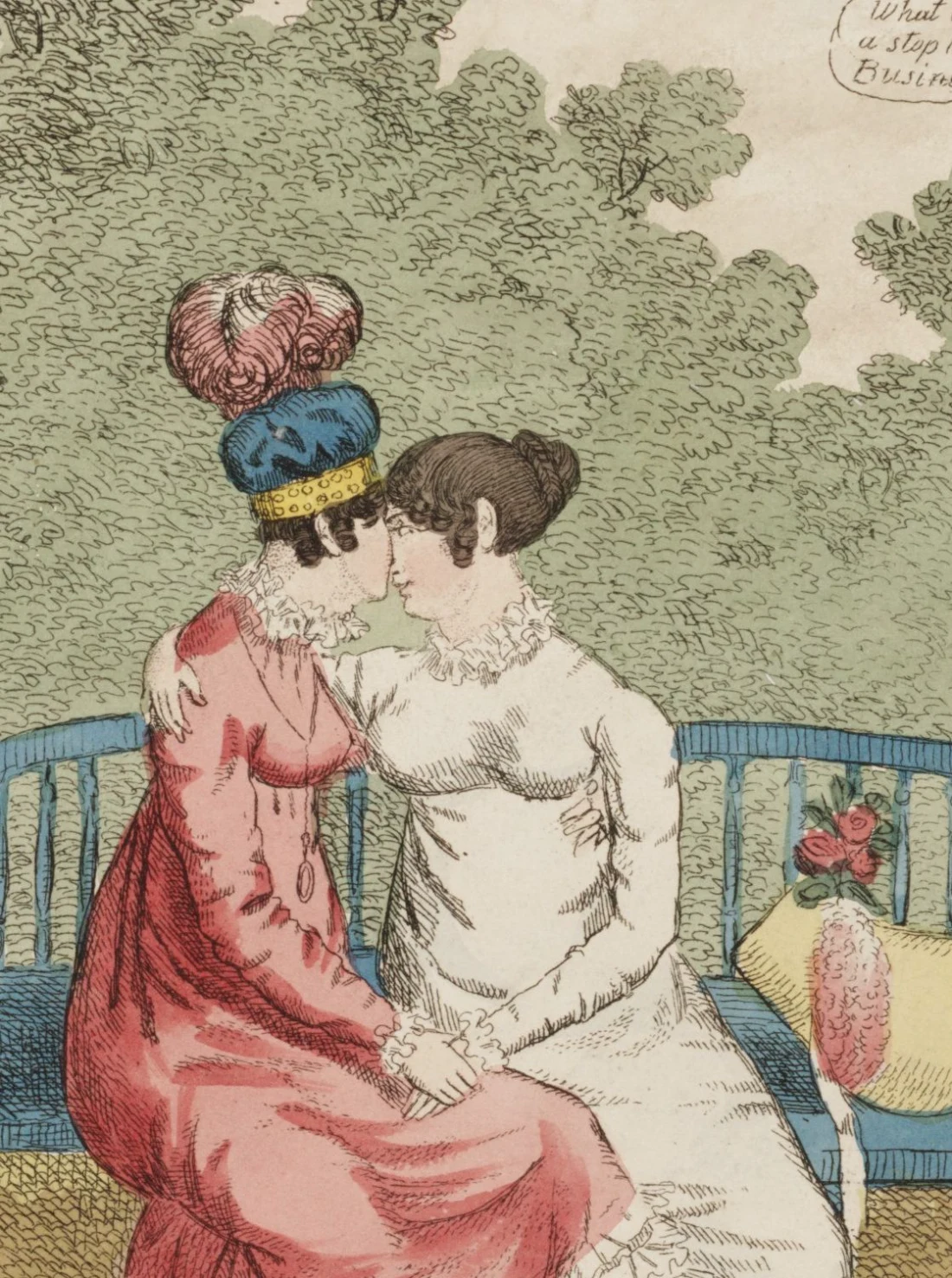
All quotations are from Pride and Prejudice and checked against the text. The hand-colored print “Love-à-la-mode, or Two Dear Friends” was published by Clinch in London in 1820 and is public domain, from the Lewis Walpole Library, Yale University. It satirizes two real society women, not Caroline, but the turban and the red gown are pure Bingley.
Keep Reading
Back to Sapphic Regency →