An EssaySapphic Regency
Were There Lesbians in the Regency Era?
Yes, and they left a paper trail
Yes. Women loved women in Jane Austen’s England, and some of them left so much paper behind that we know their stories in detail.
People ask because the period dramas most of us grew up on almost never showed it, so it can feel like it wasn’t there. It was. The proof comes from every direction, from the women themselves, from their neighbors, from gossip columns and even from a courtroom.
The women wrote it down
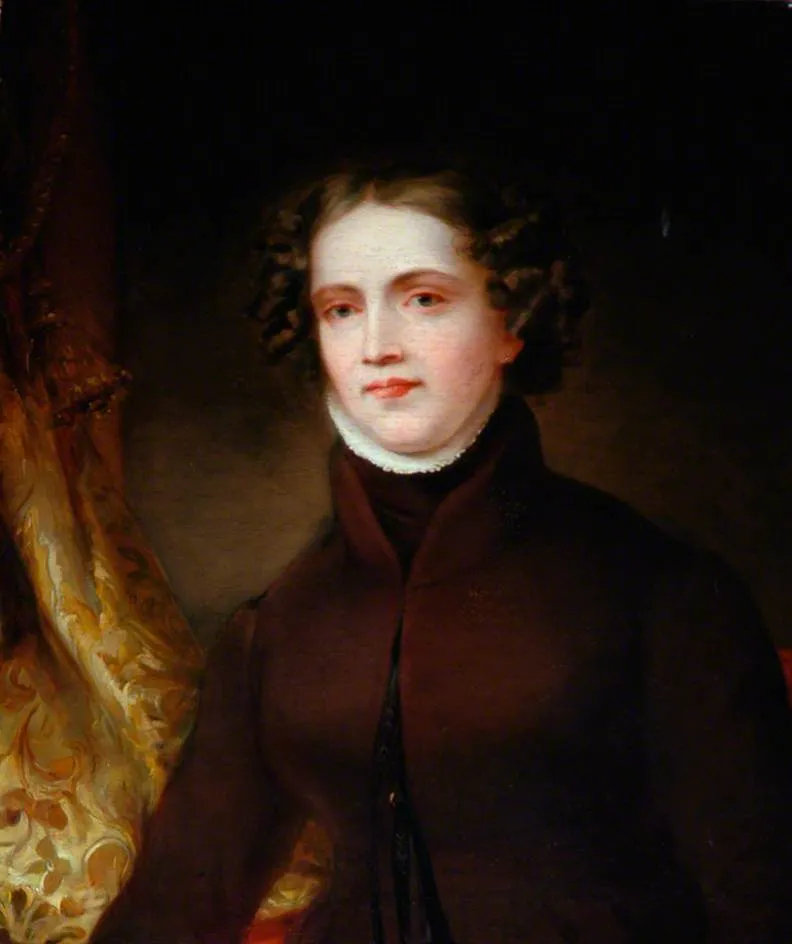
Anne Lister, a Yorkshire landowner born in 1791, kept a diary from her teens until she died in 1840. It fills more than two dozen volumes, and about a sixth of it is in a code she called her crypthand. When the code was finally broken, readers found the women she loved written down in detail.
On Easter Sunday 1834 she and Ann Walker took communion together at Holy Trinity Church, Goodramgate, in York, and from then on they considered themselves married. You can read the whole story in Anne Lister.
Letters say it too. The sculptor Anne Damer called the writer Mary Berry “my only earthly comfort.”
Couples who lived together for decades
Eleanor Butler and Sarah Ponsonby, the Ladies of Llangollen, slipped out of Kilkenny together one night in 1778, dressed as men, and spent the next fifty years side by side in a cottage in Wales. They weren’t hiding. Their visitors included the Duke of Wellington, Lord Byron and William Wordsworth, and they were granted a royal pension, said to have come on Queen Charlotte’s advice. Eleanor died in 1829 and Sarah in 1831, and they were buried together. Their story is in the Ladies of Llangollen.
Across the Atlantic, Charity Bryant and Sylvia Drake met in Weybridge, Vermont, in 1807. They ran a tailor’s shop, shared a home for 44 years and lie under one headstone. Charity’s own nephew called it a marriage. More in Charity and Sylvia.
The gossip, the magazines and the cartoons
Some of the best proof that people knew comes from the people who disapproved. In 1789 the diarist Hester Thrale wrote about women who called each other “Sapphists,” and around 1795 she noted that the thing “has a Greek name now & is call’d Sapphism.” In 1790 Town and Country Magazine ran a piece on the Ladies of Llangollen headed “Extraordinary Female Affection.”
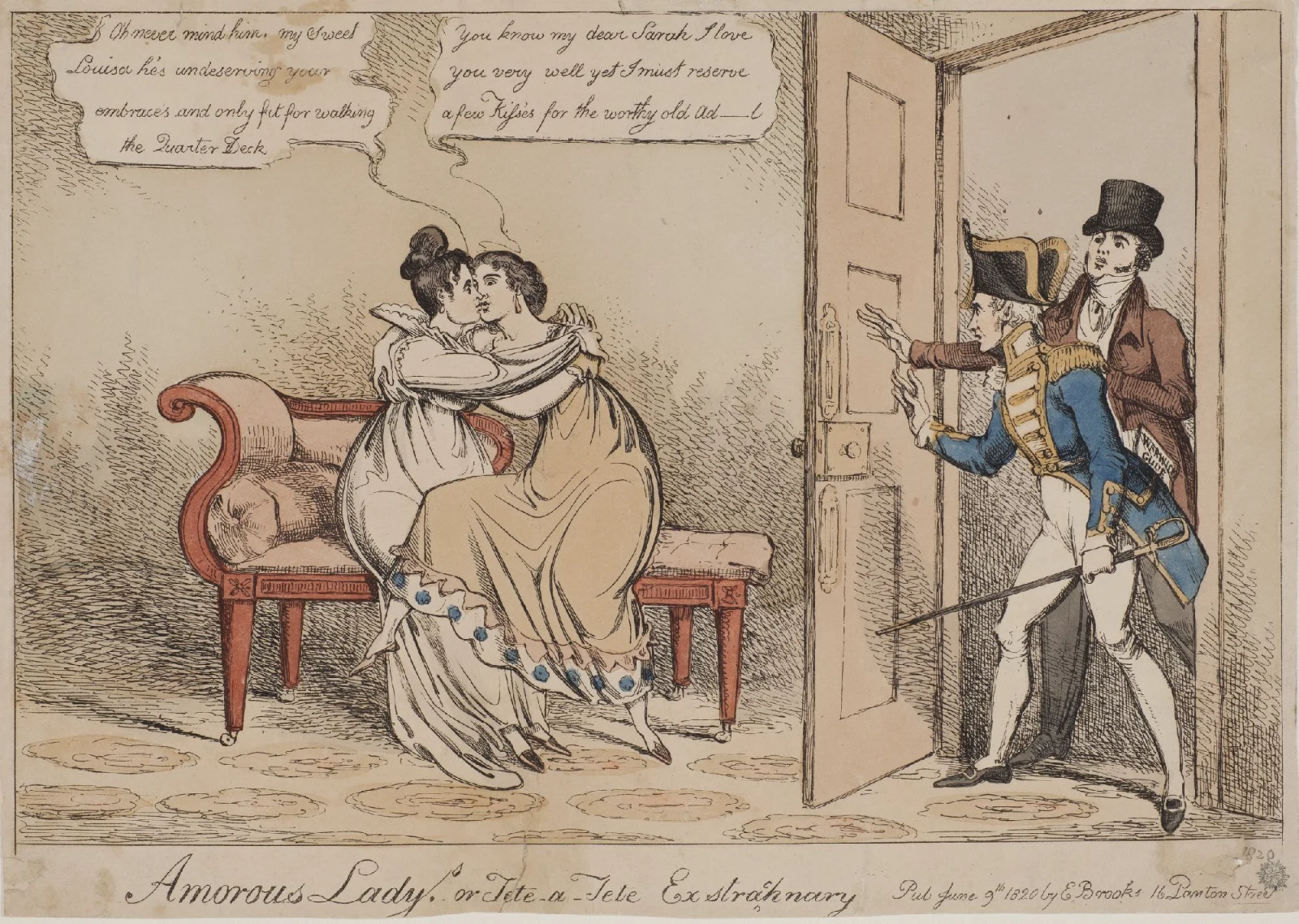
By 1820 London print shops were selling cartoons of two society women, Lady Strachan and Lady Warwick, wrapped around each other while their husbands caught them at it. A print shop doesn’t sell a joke its customers won’t get. The words people used are in Sapphists and Tommies, and the cartoons are in Two Dear Friends.
A case that ran for years
In 1810 a pupil at an Edinburgh girls’ school told her grandmother that her two teachers, Marianne Woods and Jane Pirie, were lovers. The school emptied, and the two women sued for libel. One judge admitted he had at first thought such a thing between women was “equally imaginary with witchcraft, sorcery.” The court still spent years arguing over it.
So why does it feel like they weren’t there?
Partly because there was no English law against sex between women, so there were no criminal trials of the kind that recorded so many men’s lives. Respectable people also had a gentler phrase, “romantic friendship,” and it let a lot of love pass without comment. Families burned letters. Most women never put it in plain words, and for a long time the people who wrote history and made films chose to see two women sharing a home, and then a grave, as good friends.
None of this was far from Jane Austen. She was born in 1775 and died in 1817. The Ladies of Llangollen ran away when she was a little girl, Charity and Sylvia set up house while she was living in Southampton, and Anne Lister was a young woman when Austen’s novels were coming out.
For everyone else, from Anne Damer to the women of Edinburgh, start with the women.
And in the Victorian era?
Yes, and some of the same women were still around for it. The Regency ended in 1820, and Queen Victoria came to the throne in 1837. Anne Lister lived three years into Victoria’s reign and died on her travels in 1840. Charity Bryant and Sylvia Drake shared their Vermont home until Charity died in 1851.
Plenty of people call anything with bonnets Victorian. If you’re not sure where one era ends and the next begins, I sort it out on my main site in Regency or Victorian?
Some of the best-loved sapphic stories are set in Victorian times, even though they were written much later. Sarah Waters set Fingersmith in the 1860s and Tipping the Velvet in the 1890s, and both became BBC series.
Quick Questions
Were there lesbians in the 1800s?
Yes. In the early 1800s Anne Lister was recording her relationships with women in a coded diary, Charity Bryant and Sylvia Drake were sharing a home in Vermont, and the Ladies of Llangollen were famous for their life together in Wales.
Were there lesbians in the 1700s?
Yes. The Ladies of Llangollen ran away together in 1778, and by the late 1700s gossip and satire had words for women who loved women, including “sapphist” and “tommy.”
What years was the Regency era?
Strictly, 1811 to 1820, when the future George IV ruled as Prince Regent for his father. People often use “Regency” more loosely for roughly the 1790s to the 1830s, which covers everyone on this page.
Were there lesbians in the Victorian era?
Yes. Anne Lister lived into Queen Victoria’s reign, which began in 1837, and Charity Bryant and Sylvia Drake were together in Vermont until 1851. Sarah Waters’s novels Fingersmith and Tipping the Velvet are set largely in Victorian London.
Did people in the Regency know women could love women?
Yes. Diaries, magazines, cartoons and a Scottish court case all discussed it, even when the tone was mocking or disapproving.
Sources
Anne Lister’s diaries were decoded in selections by Helena Whitbread, beginning with I Know My Own Heart (1988). Anne Damer’s words are from The Berry Papers, edited by Lewis Melville (1914). Hester Thrale’s are from Thraliana, edited by Katharine C. Balderston (Clarendon Press, 1942). “Extraordinary Female Affection” is from Town and Country Magazine, August 1790, page 363. Lord Meadowbank’s view is reported in the printed papers of Miss Marianne Woods and Miss Jane Pirie against Dame Helen Cumming Gordon (1811–1812). “Amorous Ladys, or Tête-à-tête Ex-strach-nary,” published by E. Brooks in 1820, is public domain, from the Cushing/Whitney Medical Library, Yale University. Joshua Horner’s portrait of Anne Lister is public domain.
Keep Reading
Back to Sapphic Regency →