An EssaySapphic Regency
Was Jane Austen Gay?
A queer woman on the question we can’t answer
Every few years someone asks whether Jane Austen was gay, and every few years people get very upset about it. I’m going to walk you through where the question came from and what the evidence looks like, because people deserve to know.
I’ll be honest first, though. As a queer woman, I don’t like doing this to real people who have died. We’ll never know the facts, and she isn’t here to tell us. With fictional characters I’ll happily read between every line. With Jane herself, I’d rather lay out what we know and leave the answer with her.
Where the question came from
In August 1995 the critic Terry Castle reviewed Deirdre Le Faye’s new edition of Austen’s letters for the London Review of Books. Her essay was called “Sister-Sister,” and it argued that Jane’s relationship with her sister Cassandra was the most important emotional bond of her life, and an intensely physical one.
The magazine put “Was Jane Austen Gay?” on the cover, and that’s what everybody remembers. The backlash was loud. Newspapers ran mocking headlines, Austen loyalists were furious, and the letters page filled up for weeks. Castle wrote in to say she had never claimed Austen was gay or that the sisters had a sexual relationship. She stood by her reading of how deep the bond was. By then the headline had already done its work.
The scholars who took the question seriously
Castle wasn’t alone. Claudia L. Johnson, a Princeton professor and one of the most respected Austen scholars alive, answered the uproar with her own letter to the London Review of Books. It opened with “Is she prudish? – is she queer?” and then turned the question around. Johnson was less interested in labeling Austen than in why readers get so anxious about her. Over the years Austen had been called everything from frigid to lesbian. Johnson’s point, roughly, is that Austen may never have thought of herself in those terms, and could hardly have, but her writing invites queer readings all the same. Johnson later wrote a whole book, Jane Austen’s Cults and Cultures, about the different groups of readers who have claimed Austen as their own.
A few years before Castle, the critic Eve Kosofsky Sedgwick published a 1991 essay about desire in Sense and Sensibility, reading Marianne Dashwood’s longing as something modern readers no longer know how to see. It made the newspapers too, mostly for its provocative title. Between Sedgwick, Castle and Johnson, the 1990s turned “Austen and queerness” into a real field of study, and it hasn’t gone away.
What people point to
Jane and Cassandra lived together their whole adult lives, and Jane’s letters to her are the warmest, funniest, most private writing she left. Their mother is remembered as saying that if Cassandra were going to have her head cut off, Jane would insist on sharing her fate. Neither sister ever married. Cassandra’s fiancé, Tom Fowle, died abroad in 1797, and she never accepted anyone else. Jane said yes to one proposal, from Harris Bigg-Wither in December 1802, and took it back the next morning.
Then there are the letters that aren’t there. Austen probably wrote thousands of letters, and only about 160 survive. Cassandra burned most of the rest years after Jane died and cut pieces out of others. Historians have wondered ever since what she was protecting.
Why many historians aren’t convinced
Loving, physical friendships between women were ordinary in Austen’s world. Sisters and friends shared beds, wrote each other passionate letters and called each other “my dearest,” and nobody blinked. Read with modern eyes, a lot of perfectly typical Regency affection looks like romance. The Ladies of Llangollen lived inside that same gray area, and so did the way people talked about them.
Plenty of women also stayed single for reasons that had nothing to do with desire, like money, health, a dead fiancé, or not wanting to die in childbirth the way so many of the women around them did. Austen’s novels are full of women weighing exactly those risks.
Why I won’t pick a side
Queer women did exist in Austen’s England, and some of them left us their own words. Anne Lister wrote it down in code so nobody could take it from her. That’s the difference for me. When a woman tells us who she was, I believe her. When she doesn’t, I don’t think it’s mine to decide for her, in either direction. Saying “she can’t have been” claims just as much as saying “she must have been.”
Whatever the answer, she was a sharp, private woman who loved her sister more than anyone, and she lived on her own terms as far as her world allowed. That’s the Jane I know, and it’s true either way.
Where I’m happy to read queerly: the novels
Fictional characters can’t be misrepresented, so here I’ll read as freely as I like. The most famous one is Emma and Harriet, and the one I’ve believed in for years is Caroline Bingley. I also wrote about a sapphic retelling of Emma in Happiest Season and Jane Austen’s Emma.
Quick Questions
Was Jane Austen gay?
Nobody knows, and nobody can. She never married and left no record of a romantic relationship with anyone. The question became famous after a 1995 review in the London Review of Books ran under the cover line “Was Jane Austen Gay?”
Which scholars have written about Jane Austen and queerness?
Terry Castle, whose 1995 review started the public argument, Claudia L. Johnson of Princeton, who answered it in the London Review of Books, and Eve Kosofsky Sedgwick, whose 1991 paper read desire in Sense and Sensibility.
What did Terry Castle say about Jane Austen?
Reviewing a new edition of Austen’s letters in 1995, Castle argued that Jane’s bond with her sister Cassandra was the central emotional relationship of her life. In a letter to the magazine afterwards, she said she had never claimed Austen was gay or had a lesbian relationship.
Why did Cassandra burn Jane Austen’s letters?
She never explained. Most people think she wanted to protect her sister’s privacy and the family’s. Of the several thousand letters Austen probably wrote, only about 160 survive.
Why did Jane Austen never marry?
She accepted one proposal, from Harris Bigg-Wither in December 1802, and took it back the next morning. Beyond that we only have guesses, and she didn’t leave us her reasons.
Are there queer readings of Jane Austen’s novels?
Plenty, and those are fair game because the characters are fictional. Emma and Harriet is the most famous one.
Who were the women who loved women in Austen’s time?
Anne Lister, the Ladies of Llangollen, Anne Damer and others. They’re all on Sapphic Regency.
Sources
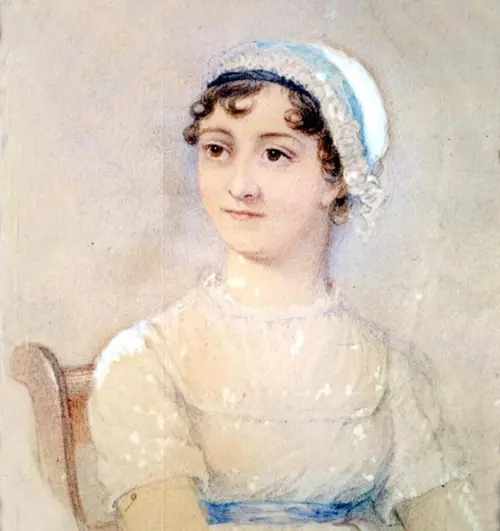
Jane Austen’s portrait is Cassandra Austen’s sketch, about 1810, public domain. The account of the 1995 controversy draws on Terry Castle’s review “Sister-Sister” and the letters that followed in the London Review of Books, including Claudia L. Johnson’s, and on the Morgan Library’s estimate of Austen’s surviving letters. Novel quotations are checked against Austen’s text.
Keep Reading
Back to Sapphic Regency →