An EssaySapphic Regency
Emma and Harriet
Jane Austen’s most famous queer reading, quote by quote
If you ask Austen readers where the queer reading lives, most of them will point to Emma. Emma Woodhouse meets Harriet Smith, can’t stop looking at her, paints her portrait, and spends half the novel deciding who Harriet should love. Meanwhile she announces she never intends to marry at all.
Emma is fictional, so I’ll read her as freely as I like. Every quote here is Austen’s, and you can decide for yourself what it adds up to.
“Of a sort which Emma particularly admired”
Austen doesn’t hide it. The first time Emma meets Harriet, we’re told that Harriet’s “beauty happened to be of a sort which Emma particularly admired,” followed by a full description of it. “She was short, plump, and fair, with a fine bloom, blue eyes, light hair, regular features, and a look of great sweetness.” By the end of that first evening Emma is “so busy in admiring those soft blue eyes” that the time flies by.
Emma has just lost Miss Taylor, her governess and closest companion, to marriage, and Hartfield is quiet. She decides Harriet is “exactly the young friend she wanted,” and “exactly the something which her home required.” She’s twenty-one, rich, bored and alone with her father, and the person she chooses to fill that space is a pretty seventeen-year-old she can’t stop watching.
The portrait
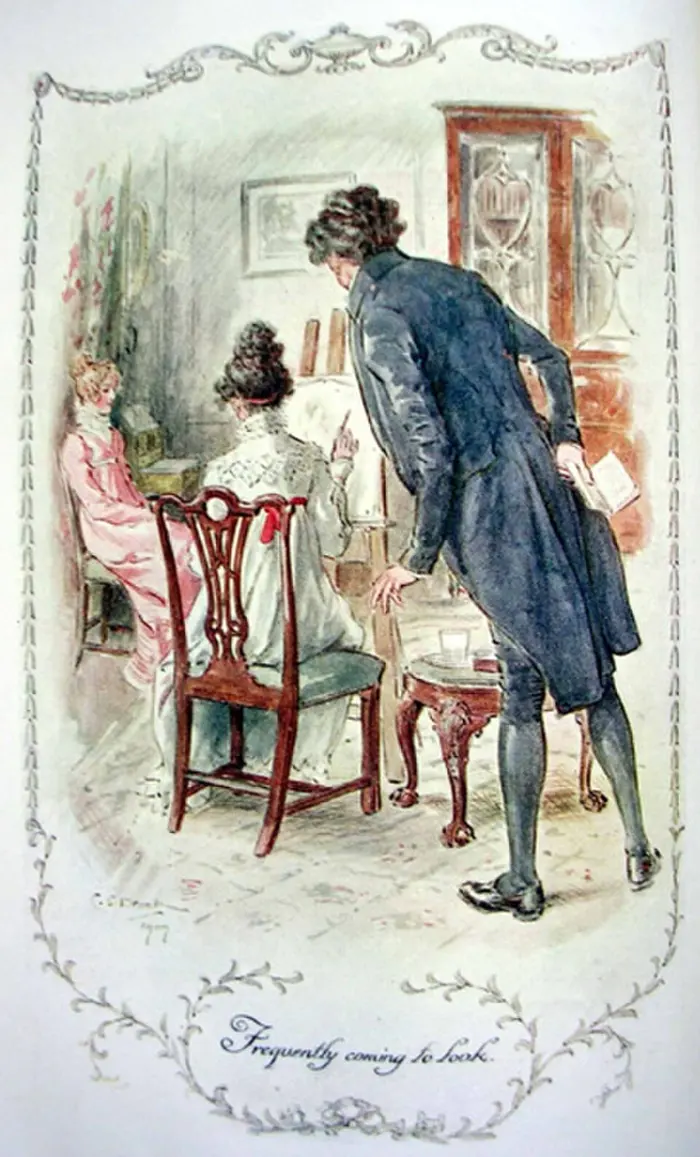
Emma decides to paint Harriet. The official reason is to give Mr. Elton an excuse to admire her friend. But it’s Emma who spends the sittings studying Harriet’s face, and Emma who improves on it. Mrs. Weston says Emma “has given her friend the only beauty she wanted.” Mr. Knightley is blunter. “You have made her too tall, Emma.” Austen adds that “Emma knew that she had, but would not own it.”
It’s a small moment, and it’s the one I always come back to. Emma doesn’t paint Harriet as she is. She paints her as Emma sees her.
Keeping Harriet close
When the farmer Robert Martin proposes to Harriet, Emma talks her out of it. Her stated reason is class, that Harriet can do better. But the effect is that Harriet stays at Hartfield, with Emma, and Emma keeps choosing the men in Harriet’s life for her. First it’s Mr. Elton, then she half-hopes for Frank Churchill.
Mr. Knightley sees the attachment and hates it. “I think her the very worst sort of companion that Emma could possibly have,” he tells Mrs. Weston. Read one way, he’s a sensible friend worried about a bad influence. Read another, he’s a man watching the woman he loves give all her attention to someone else.
“None of the usual inducements”
Emma tells Harriet, plainly, that she doesn’t plan to marry. “I have none of the usual inducements of women to marry,” she says. She has never been in love, and “it is not my way, or my nature.”
Part of that is money. Emma is an heiress with her own home, so she doesn’t need a husband the way Harriet does. But “it is not my way, or my nature” is a striking thing for a heroine to say about men, and Austen gave the line to the one heroine who spends the novel fixated on another woman.
The arrow, and the goodwill
In fairness, the ending pulls the other way. Emma realizes she loves Mr. Knightley at the exact moment Harriet admits she hopes to marry him. “It darted through her, with the speed of an arrow, that Mr. Knightley must marry no one but herself!” It’s a real love story, and the book wants you to believe it.
But look at what it costs Harriet. Once Harriet marries Robert Martin after all, Austen says that “The intimacy between her and Emma must sink,” and that “their friendship must change into a calmer sort of goodwill.” The most intense relationship in the novel just fades out. I find that one of the saddest sentences Austen ever wrote, whichever way you read the two of them.
Emma and Harriet in the adaptations
Clueless turns them into Cher and Tai, a makeover friendship with all the same jealousy. The 2020 Emma with Anya Taylor-Joy and Mia Goth plays the two of them so close that a lot of viewers came away with the same reading. I wrote about why I love that version, and about a sapphic retelling with Austen’s bones in Happiest Season and Jane Austen’s Emma.
Quick Questions
Is Emma Woodhouse gay?
Austen never says so, and the novel ends with Emma happily marrying Mr. Knightley. But her fascination with Harriet Smith is one of the most discussed queer readings in English literature, and the text gives it a lot to work with.
Why is Emma so interested in Harriet Smith?
Austen says Harriet’s beauty was “of a sort which Emma particularly admired,” and that Emma decided Harriet was “exactly the young friend she wanted.” Her sister-like friend Miss Taylor has just married, and Emma is lonely.
What happens to Emma and Harriet’s friendship?
It fades. Once Harriet marries Robert Martin, Austen says their intimacy “must sink” into “a calmer sort of goodwill.”
Did Emma paint Harriet’s portrait?
Yes. Mr. Knightley tells her “You have made her too tall, Emma,” and Austen adds that Emma knew she had.
Does Emma ever want to marry?
Not at first. She tells Harriet “I have none of the usual inducements of women to marry” and that she has never been in love. She changes her mind about Mr. Knightley near the end.
Are there other queer readings of Austen?
Yes. I’ve read Caroline Bingley as gay for years, and I wrote about whether Jane Austen herself was gay.
Sources
All quotations are from Emma and checked against the text. The illustration is C. E. Brock’s, from 1909, public domain.
Keep Reading
Back to Sapphic Regency →